Products
SEO and GEO Weekly: When AI Speaks for Your Brand

This is the weekly SEO and GEO digest, 4 to 11 November 2026. The theme of the week is that Google’s AI answers have taken over the moments that used to be pure brand surface. A core update lands before the shopping peak, a new frontier model now drives AI Mode, the local pack is tested without its buttons, and two vendor panels put hard numbers on the shift. The position at the end is mine and it is blunt.
Google’s November core update rolls out, and the timing bites
On 10 November 2026, Google logged the November 2026 core update on the Search Status Dashboard, a global change to all languages that the company says may take up to two weeks to complete. Google calls it a regular update “designed to better surface relevant, satisfying content for searchers from all types of sites,” and Search Engine Roundtable broke the rollout with the context that matters: it is the third core update of 2026 and the first since May. Status: official, confirmed by Google on the dashboard and on LinkedIn. The timing is the story. A full two-week rollout ends around 24 November, days before the holiday shopping peak, and Google’s core update guidance tells publishers to wait at least a week after a rollout before comparing performance. My take: any site that loses position now will not be able to diagnose why until the season is over, so the visibility you carry into this update is largely the visibility you finish the year with.
Gemini 4 Carbon now drives AI Mode for the top Google plan
On 10 November 2026, Search Engine Land reported that Google’s newest frontier model, Gemini 4 Carbon, is now selectable in AI Mode within Search for Google AI Ultra subscribers, rolling out the same day across Antigravity and the Gemini app. The model itself was announced on 28 October 2026 on the Google blog, and Google frames it as its strongest model with state-of-the-art cybersecurity and long-horizon agentic skills. Status: official, from Google’s own release and product announcement. My take: this is a citation surface changing under us. Google’s answer engine now runs the newest frontier model, and every GEO conclusion about “which engine and which model” wants re-asking the week the model behind the answers swaps.
Google tests a local pack with the buttons removed
On 10 November 2026, Search Engine Roundtable reported Google is testing a stripped-down AI Overview version of the local pack that drops the action buttons, photos, reviews, address and hours. Local consultant Joy Hawkins spotted it on mobile and said whenever this version shows up the traditional local pack is gone; Barry Schwartz replicated it and wrote the plain reading: the tested version “cannot be good for clicks, calls and direction actions to businesses.” Status: a test, not a launched change, and not confirmed by Google. My take: local is next to feel the squeeze that hit organic. When the pack loses its buttons, calls and directions stop being a click on Google and become whatever the AI answer says, so the business named in the answer is the business that gets found. Clean profile data and consistent mentions everywhere are the only defence.
Ahrefs: AI Overviews now answer 83 percent of branded searches
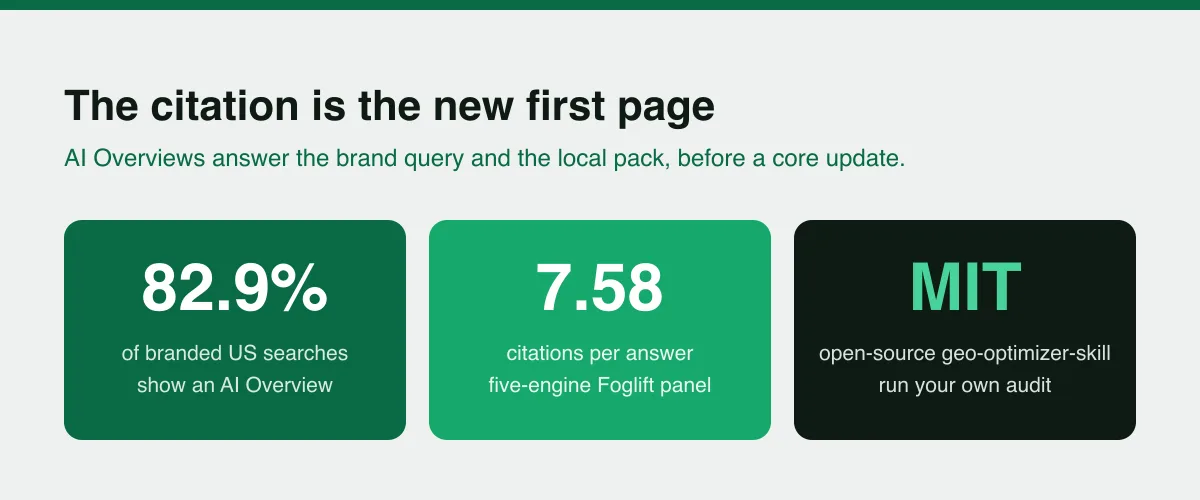
Ahrefs, the SEO platform, studied 232.8 million US desktop search-result crawls from July to September 2026 and found that as of 29 September AI Overviews appeared for 82.91 percent of branded queries, up from 61.3 percent in July. Vendor label: Ahrefs is a tool company publishing its own data, but it states its crawls, its sample split and its date, which is the standard to hold every such study to. The harder finding is the second one: 76.2 percent of those branded AI Overviews appeared in position one, and the sources cited most were Wikipedia, YouTube and LinkedIn, not the brand’s own domain. Status: vendor study. My take: a brand query no longer returns a page a brand wrote about itself. It returns a summary written from third parties who were never asked, and the citations decide the story. That gap is the GEO brief, and most companies have not started it.
Foglift’s five-engine panel puts numbers on the answer
Foglift, a GEO monitoring tool, published on 3 November 2026 the latest edition of its GEO Statistics Report, a five-engine panel of 65,558 AI answers and 100,680 query fan-outs measured from 20 March to 3 November 2026. In the Google AI Overviews slice it measured 7.58 citations per answer on average and an inclusion rate of 84.3 percent. Vendor label: Foglift sells AI visibility monitoring, so it is measuring the market it sells into, and it publishes its sample, its window and its per-engine numbers, which is the methodological floor too much of the GEO industry still misses. Status: vendor study with declared methodology. My take: I would rather quote this report than any blended dashboard, because the denominators are on the page. Citations per answer and inclusion rate are concrete; a single opaque “visibility score” is not.
Open-source GEO you can run yourself
For tools you can verify by hand, two repositories carry the spirit this week. NomaDamas/geobench (71 stars as of 11 November 2026, created in May) presents itself as an open-source alternative to the paid GEO trackers, scoring how visible a brand is in LLM answers with hit rate, MRR, share of voice and citations across OpenAI, Anthropic, Google, Perplexity and xAI, and it ships a local dashboard. Auriti-Labs/geo-optimizer-skill (1,308 stars, MIT, created in February) is the open-source engine behind the hosted GeoReady audit, scoring a site 0 to 100 on whether ChatGPT, Perplexity, Gemini and Google AI Overviews can crawl, parse and cite it, and it runs as a CLI, Python library, MCP server and GitHub Action. Both state their method and both let you re-check the score yourself. My take: in a week of vendor numbers, the radical move is running your own audit. A self-run check costs little more than your API keys and answers the one question the dashboards dodge: can an engine actually read your site?
What I make of this week
Here is where I stop summarizing and take a position.
The through-line is that AI answers now own the moments that used to be the brand’s homepage. A branded query returns an AI Overview 82.9 percent of the time, usually in position one, written from your third parties. The local pack is being tested without the buttons that send customers to you. The newest frontier model drives the AI Mode that answers with fewer clicks outward. And Google launched a core update three weeks before the shopping peak, so the visibility you have going in is largely the visibility you will end the season with.
My position is blunt: the citation is the new first page, and most companies still have zero confirmed citations. The data worth trusting this week comes from studies that publish their window and their sample, like Ahrefs and Foglift, and from tools you can run and re-run yourself, like geobench and geo-optimizer-skill. Every personalized “visibility score” that hides its method is the modern equivalent of a poisoned tracker: a number that looks true and is not. If a search for your business returns a summary written from Wikipedia and LinkedIn, that is not a bug, it is your data, and it tells you exactly where to start. Get the citations right, and the rankings and the traffic follow the answer engine’s logic, not the other way around.
We build search and AI visibility work on verified, first-party measurements. If you want to know what the engines actually cite and say about your brand instead of what a dashboard guesses, get in touch.