Products
SEO and GEO Weekly: Links, Ads, and Official Sources in AI Search

This is the weekly SEO and GEO digest, 14 to 21 October 2026. Google put more links into its AI answers, and new data shows how rarely ChatGPT searches the web. Both trends push traffic toward official and primary sources.
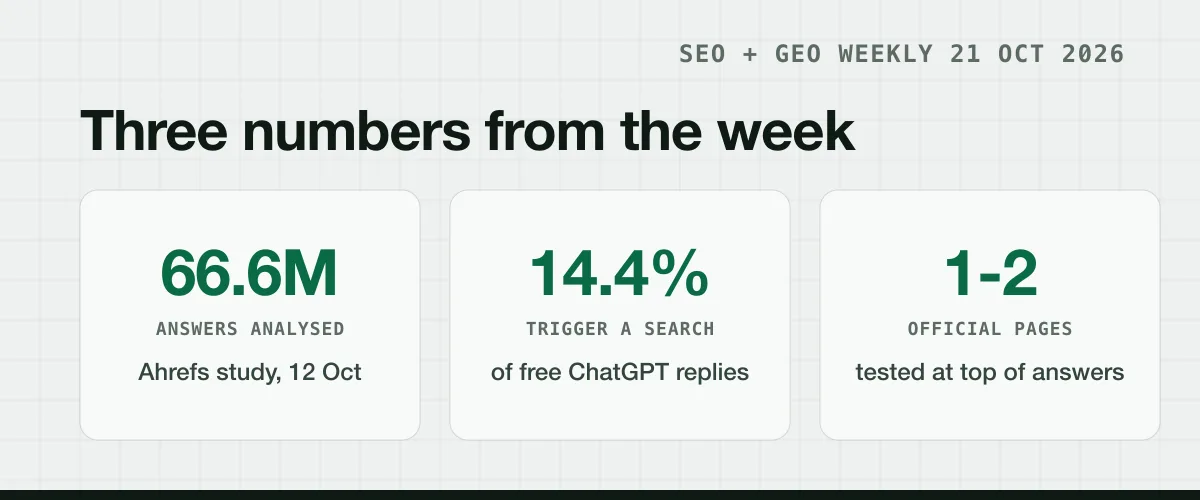
Google gives AI answers more links
On 15 October 2026, Google announced that inline links in AI Mode and AI Overviews now sit higher and appear more often. For task queries like refunds, bookings, and filings, Google is testing a block of one or two official pages at the top of the answer. Each link comes with a note on why it helps. News carousels are expanding, and Google is testing clickable author names.
Ads return to AI Mode
On 16 October 2026, Google confirmed to Search Engine Land that it is testing ads in AI Mode for users with Personal Intelligence enabled. It is a reversal of the earlier plan to keep AI Mode ad free. Search Engine Roundtable carried the same report. The test shows where Google means to make money from AI answers.
Gemini 4 Argon lands in AI Mode
On 14 October 2026, Google released Gemini 4 Argon into AI Mode for Pro and Ultra subscribers worldwide, as Search Engine Roundtable reported. The responses keep their citation links, so the sources stay visible. For tracking, the model change matters less than the links that survive it.
A missing label, and a tracker warning
On 20 October 2026, Search Engine Roundtable reported that the AI Overviews label seems missing on desktop for some queries, while the same query shows it on mobile. It is a single observer report, and it is unconfirmed. If the label disappears, automated trackers could report AI Overviews drops that never happened.
What the ChatGPT data says
An Ahrefs study, published 12 October 2026, looked at 66.6 million free, logged-out ChatGPT responses. Only 14.4 percent of them triggered a web search. When ChatGPT did search, it aimed site-restricted queries at official and brand domains. Citations shifted from aggregators and Reddit toward primary sources, with PubMed moving from 64th to 4th place. This is one vendor’s analysis of its own dataset, not market truth, but the direction matches everything else this week.
A curated home for GEO tools
The open-source side of the field keeps growing. The awesome-generative-engine-optimization list on GitHub collects tools, papers, and guides, and it is ongoing rather than dated. The GitHub topic ‘generative-engine-optimization’ links related projects in one hub.
What I make of this week
Two giants are converging from different directions. Google tests official-page blocks for task queries, while ChatGPT shifts citations to primary sources, so both push AI traffic to the sites users would choose anyway. Google still withholds click data, which keeps that traffic hard to measure. For a small consultancy, the durable move is to make each client’s site the unambiguous official place for its facts and tasks, then check live SERPs and Search Console before panicking over a tracker-level AI Overviews dip.
Contact: get in touch.