Products
GitHub Weekly: Five Repos Worth Your Attention This Week

Every Monday we take a lap around r/BestGitHubRepos and pick the five open source projects worth your time. The bar is simple: real stars, a recent release, and something that changes how you build or create. Here is the set for this week, covering the window from 19 to 26 October 2026. Stars and release data are as of 26 October 2026, checked on GitHub.
1. mattpocock/skills, a senior engineer’s real working files
Matt Pocock open-sourced his entire .agents directory (repo). These are production engineering skills: code review patterns, refactoring workflows, debugging chains. Not tutorials, not blog posts, the files he uses day to day. The repo is mostly Shell and JavaScript, MIT licensed, and it passed 300,000 stars during this week, the fastest star climb we tracked this week. The latest release is v1.3.1 from 4 October.
My take: the star count tells you people are tired of generic advice. They want the actual working files of a senior engineer, not a cleaned-up version. Curation is the product here, and it shows what a mounted skill directory should look like.
2. OpenSRE, an evaluation ground for AI incident response
OpenSRE is the open source framework for AI SRE agents (repo). It connects 60+ tools that teams already run, defines incident workflows, and answers production questions on your own infrastructure. The bigger bet is an open reinforcement learning environment for incident response, with end-to-end tests for realistic failure scenarios. It is Python, Apache 2.0, with about 12,500 stars, and the latest release is v0.1.2026.10.26 from today. It is a public alpha.
My take: SWE-bench fixed evaluation for coding agents. Nobody has done the same for production debugging, and that is why AI for incidents still feels like magic tricks. An evaluation ground is worth more than another demo. This is the right problem to attack.
3. PilotDeck, an agent OS built around workspaces
PilotDeck is an open source agent operating system organized around “WorkSpaces” (repo). It is built by Tsinghua’s THUNLP lab, ModelBest, OpenBMB and AI9Stars. Tasks, files and context live in a visible workspace instead of a chat history, and you choose your own models. It is TypeScript, AGPL 3.0, with about 4,900 stars and a release on 20 October (v2026.10.20).
My take: chat history is a terrible memory for real work. A workspace you can see, share and version matches how teams actually operate. This is the design bet that could make agents feel like colleagues instead of chat windows.
4. Mercury Agent, an assistant that asks before acting
Mercury Agent is a permission-hardened AI assistant that asks consent before dangerous actions (repo). It ships with token budgets, multi-channel access from CLI or Telegram, and runs 24/7. It is TypeScript, MIT licensed, with about 3,600 stars and a release on 24 October (v1.4.2).
My take: asking before acting is not a limitation, it is production readiness. The agents that will run inside companies are the ones that can say “I am about to spend budget and touch real data, confirm?”. Consent is the missing layer between demo and deployment.
5. PatchMon, the boring layer that keeps agents honest
PatchMon is an enterprise-grade Linux patch and server management platform (repo). A lightweight agent reports outbound-only to the server, so monitored hosts need no inbound ports, and policies support dry-run, approval and audit trails. It is Go, AGPL 3.0, with about 3,500 stars and a release on 17 October (v2.1.6).
My take: nobody stars a patch manager for fun. But every agent that touches a server inherits the state of that server, and unpatched machines are the real attack surface. The unglamorous layer wins again.
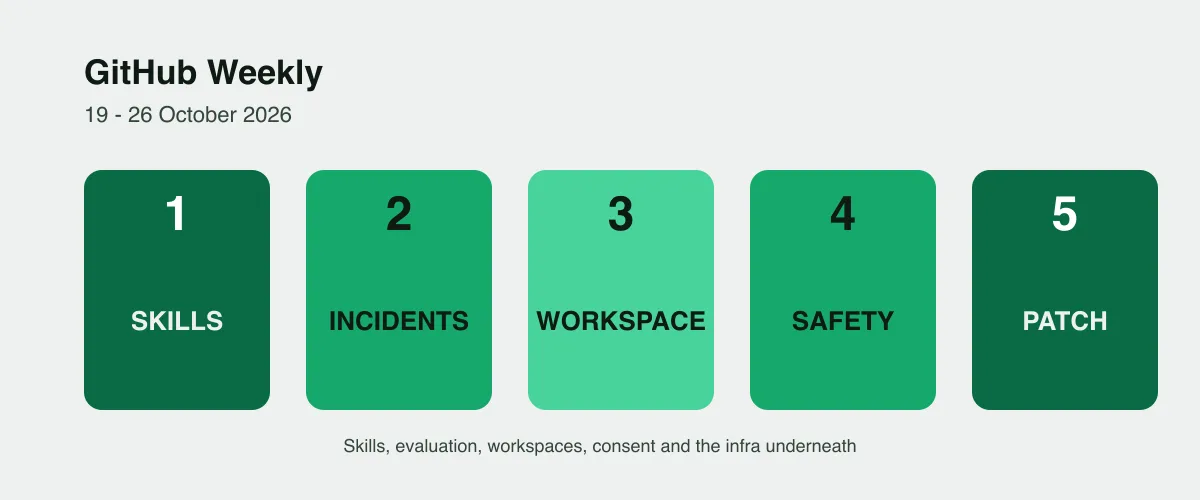
What connects this week
Five tools, one shift. Agents are leaving the demo stage and getting real jobs with guardrails. Pocock’s skills give them expertise, OpenSRE gives them an evaluation ground, PilotDeck gives them a workspace, Mercury gives them consent, and PatchMon keeps the machines underneath safe. The common pattern is governance: how an agent gets knowledge, gets tested, and gets permission before it touches something real.
My honest position: the race to collect skill files is entertaining, and 300,000 stars prove a hunger for real working material. But skills without evaluation are just opinions, and the repos that will change how we ship AI are the ones that measure agents and stop them from acting alone. A benchmark named OpenSRE and a consent layer named Mercury matter more than the thousandth prompt library. Skills give an agent a voice. Evaluation and permission give it a spine.
We are a boutique consultancy that ships AI to clients. We build systems where the agent proposes and a person decides, and we care about this trust layer. If you want agents that are skilled, measured and governed, we are here. (Contact)